China has become a major production center for Fitness Tracker Watches, supported by mature electronics, sensors, batteries, and assembly networks. The opportunity is substantial. IDC reported that global wearable device shipments reached approximately 520 million units in 2023, covering watches, bands, and related devices. Its Worldwide Quarterly Wearable Device Tracker also identified continued demand for health monitoring, sports tracking, and affordable connected devices.
Market growth is not evenly distributed. Counterpoint Research’s Global Smartwatch Shipment Tracker shows strong competition among established brands and Chinese manufacturers. Many suppliers now offer heart-rate monitoring, sleep analysis, blood oxygen tracking, GPS, AMOLED displays, and mobile-app integration. However, specifications alone do not prove manufacturing capability. A factory may present an impressive sample, yet struggle with firmware stability, waterproof testing, or consistent batch quality.
This guide examines ten leading Chinese Fitness Tracker Watches manufacturers through practical criteria. These include production experience, certification readiness, research and development capacity, minimum order quantities, customization support, quality control, and export performance. Public company information, industry reports, and supplier evidence should be compared carefully. Some rankings remain subjective. Data transparency is still imperfect.
That matters to importers, private-label brands, retailers, and fitness technology companies. A dependable manufacturer should provide clear test records, realistic delivery schedules, and responsive technical support. The best partner is not always the cheapest one. It is the supplier that can repeatedly deliver accurate sensors, durable straps, stable software, and compliant products at commercial scale.
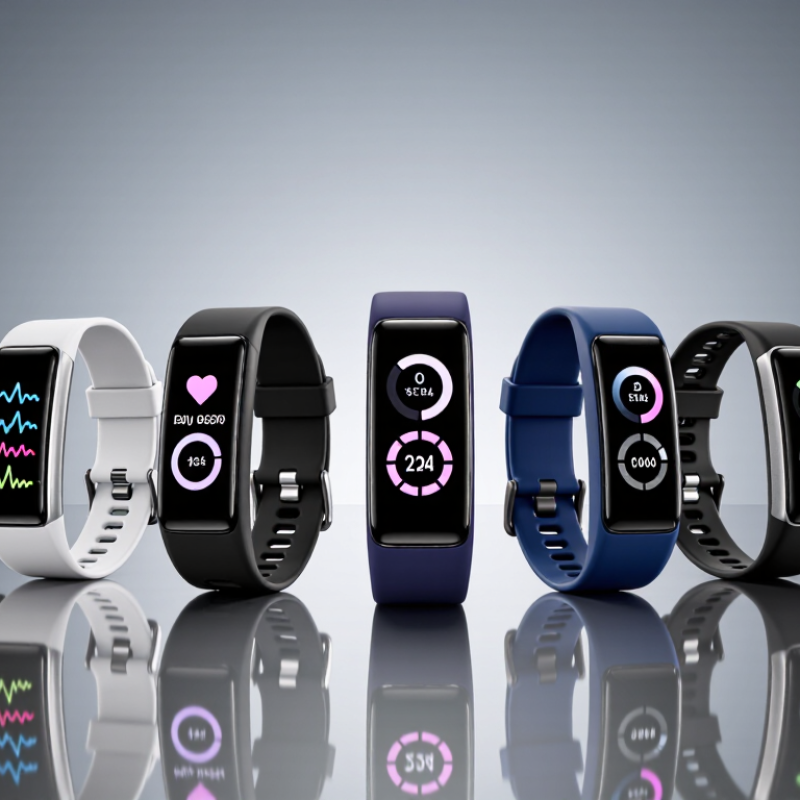
Fitness tracker watches are wearable devices that estimate movement, exercise, heart rate, and sleep. IDC’s Worldwide Quarterly Wearable Device Tracker reported about 520 million wearable devices shipped worldwide in 2023. This demand reflects a simple need: people want health information during ordinary routines, not only in clinics.
A tracker uses a three-axis accelerometer to detect steps, arm movement, and workout intensity. A gyroscope adds information about wrist rotation and body position. Optical sensors shine green or infrared light into the skin, then measure blood-volume changes for heart-rate estimates. Algorithms convert these signals into calories, distance, stress, and sleep patterns. Bluetooth sends the readings to a mobile application. The process looks effortless.
The numbers are estimates.
A 2024 review in npj Digital Medicine found that wearable heart-rate measurements can be reasonably accurate during steady exercise, but performance often changes during intense movement or poor skin contact. Sleep-stage results are less certain. Grand View Research also identifies health monitoring as a major driver of the global wearable technology market, though market forecasts vary by definition and region. Users should check sensor fit, battery condition, and measurement conditions. These watches can reveal useful patterns, but they cannot replace professional diagnosis. Even step counts may differ between devices, which is an uncomfortable detail worth remembering.
China Top 10 Fitness Tracker Watches Manufacturers?
China has become a major fitness tracker watch manufacturing hub because its supply chain is unusually dense. In cities such as Shenzhen and Dongguan, factories can source displays, optical sensors, batteries, casings, and charging components from nearby suppliers. That proximity matters. Engineers can test a revised housing in days, not weeks, while tooling teams quickly adjust molds for different wrist sizes.
Manufacturers also benefit from mature electronics expertise. Production lines commonly use automated assembly, optical calibration equipment, waterproof testing, and battery safety checks. Skilled technicians can integrate heart-rate sensors, motion tracking, Bluetooth modules, and compact software into one small device. Local logistics networks further support fast movement from component suppliers to assembly plants and export warehouses. This combination helps buyers develop private-label products with flexible quantities and practical cost control.
The picture is not flawless. Speed can encourage rushed testing, especially when buyers focus only on appearance or price. Reliable manufacturers should provide traceable inspection records, firmware testing, material declarations, and clear quality procedures. Independent sampling remains valuable. A polished sample may hide inconsistent production. Experienced buyers therefore examine repeated batches, sensor accuracy, charging performance, and strap durability. China’s advantage is not simply cheap labor; it is the coordination of engineering, manufacturing, testing, and logistics. Yet every supplier still needs careful evaluation.
China’s position in electronics manufacturing is supported by its large industrial base, strong export network, advanced factory automation, and continued investment in research and development.
The indicators use different denominators and are shown for context rather than as a direct ranking. Manufacturing value added and merchandise exports are based on 2023 international statistics; industrial robot installations are based on 2023 IFR data; R&D intensity is China’s 2023 R&D expenditure as a percentage of GDP.
China Top 10 Fitness Tracker Watches Manufacturers: Key Criteria for Evaluating Chinese Fitness Tracker Manufacturers
Choosing among the top ten Chinese manufacturers requires more than comparing prices. Examine production experience, engineering depth, and quality control records. Ask how long the factory has produced wearable devices. Review its sensor testing process, battery checks, and waterproofing procedures. A reliable supplier should provide clear test reports and traceable production data. Factory audits also matter. Clean work areas and calibrated equipment reveal operational discipline. However, a polished showroom proves very little.
Technical capability deserves close attention. Check heart-rate accuracy, step-count consistency, screen durability, and Bluetooth stability. Request independent testing samples before placing a large order. Confirm whether firmware can be updated securely. Data protection should receive equal attention. Ask where user data is stored and how access is controlled. Manufacturers should explain their privacy practices in plain language. Do not accept vague promises. Some suppliers may claim medical-level accuracy without suitable evidence, which requires careful review.
Tips: Compare three sample batches, not one. Test charging time, strap comfort, app translation, and performance during exercise. Ask for references from similar buyers. Inspect packaging and manuals for hidden quality issues. Keep written specifications in the contract. A small pilot order reduces risk. Even experienced buyers can miss software defects or delayed support. Recheck every claim independently.
| No. | Evaluation Dimension | Evidence-Based Benchmark | Recommended Verification Method | Suggested Weight | Why It Matters |
|---|---|---|---|---|---|
| 1 | Manufacturing Capability | Documented production lines, assembly capacity, engineering resources, and stable supplier relationships. | Review factory audit reports, production-flow videos, capacity statements, and sample-order performance. | 15% | Helps reduce delivery delays and production bottlenecks. |
| 2 | Product Accuracy | Heart-rate, step-count, sleep, and activity measurements should be tested against recognized reference equipment or published validation procedures. | Request test protocols, independent laboratory results, and comparative sample data under defined conditions. | 15% | Core tracking quality directly affects user trust and returns. |
| 3 | Certifications and Compliance | Relevant market requirements may include CE, FCC, RoHS, REACH, UKCA, and UN38.3 or IEC 62133 documentation where applicable. | Check certificate numbers, issuing laboratories, test scope, expiry status, and model consistency. | 14% | Supports lawful import, safer products, and fewer customs issues. |
| 4 | Hardware and Sensor Integration | Transparent specifications for optical sensors, accelerometers, gyroscopes, displays, batteries, charging systems, and water resistance. | Compare engineering drawings, component lists, datasheets, and physical samples. | 11% | Shows whether specifications are consistent and technically credible. |
| 5 | Software and App Support | Stable firmware, mobile applications for major operating systems, Bluetooth compatibility, update procedures, and data-export capability. | Test pairing, synchronization, notifications, firmware updates, language support, and app-store availability. | 10% | Poor software support can make otherwise capable hardware unusable. |
| 6 | Battery and Durability | Battery-life claims should identify test conditions; enclosure and water-resistance claims should be supported by applicable test evidence. | Conduct repeated battery tests and request ingress-protection or water-resistance reports for the exact model. | 9% | Improves reliability during sports, travel, and daily wear. |
| 7 | Quality-Control System | Documented incoming-material inspection, in-process testing, final inspection, traceability, and corrective-action procedures. | Review ISO 9001 evidence where available, inspection records, defect-rate reports, and warranty-return analysis. | 9% | Consistent controls lower defect rates and after-sales costs. |
| 8 | Customization and OEM/ODM Support | Ability to customize industrial design, watch faces, firmware, packaging, languages, accessories, and application functions. | Request a customization matrix, development timeline, sample process, tooling terms, and intellectual-property clauses. | 7% | Determines how effectively the product can fit a target market. |
| 9 | Pricing and Total Cost | Evaluation should include unit price, tooling, packaging, certification, software, logistics, warranty, and minimum-order costs. | Prepare a landed-cost comparison using identical specifications, quantities, Incoterms, and payment conditions. | 6% | The lowest quoted price is not always the lowest total cost. |
| 10 | Communication and After-Sales Service | Clear technical communication, spare-part availability, warranty terms, response procedures, and long-term firmware support. | Use a pre-sales technical questionnaire and review service-level commitments before signing. | 4% | Fast support protects launch schedules and customer satisfaction. |
| Total Suggested Evaluation Weight | 100% | Use weighted scores for objective comparison. | |||
China’s Top 10 Fitness Tracker Watch Manufacturers should be judged by capability, not website appearance. A reliable supplier should show working samples, production records, and clear quality procedures. Buyers should inspect sensor accuracy, battery performance, screen durability, and charging safety. A practical factory visit may reveal testing benches, clean assembly lines, and organized component storage. Small details matter.
Manufacturers in this group often provide OEM and ODM services for retailers, gyms, and corporate wellness programs. Strong suppliers can customize straps, watch faces, packaging, and companion applications. They should also explain data protection practices in simple language. Factory audits, sample testing, and independent laboratory reports can reduce costly mistakes. Do not trust impressive prototypes alone. A polished demo may hide weak mass production. Some suppliers respond quickly but lack stable component sourcing. Others offer lower prices, yet their after-sales support feels uncertain. I would compare at least three production samples before choosing one. No supplier is perfect. Even experienced buyers can overlook software updates, regional certifications, or replacement-part availability. The best evaluation remains careful, documented, and slightly skeptical.
Choosing among China’s top fitness tracker watch manufacturers requires more than comparing factory prices. IDC’s Worldwide Quarterly Wearable Device Tracker reported approximately 537.7 million wearable devices shipped globally in 2024, showing strong demand but also intense competition. Ask each manufacturer for recent production volumes, defect rates, and delivery records for similar products. A polished sample is useful. It is not enough.
Check the manufacturer’s engineering depth before discussing large orders. The team should explain sensor calibration, battery testing, waterproof protection, firmware updates, and mobile-app compatibility in clear terms. Request test reports from recognized laboratories and verify whether the stated results match your target market’s requirements. Also review production capability, minimum order quantity, tooling fees, packaging options, and after-sales response times. These details often affect profit more than the initial unit price.
The Global Wellness Institute valued the global wellness economy at 5.6 trillion dollars in 2022, reflecting sustained consumer interest in health-related products. However, market growth does not guarantee product success. A manufacturer may promise fast customization, yet struggle with stable software or replacement parts. Test a pilot batch for several weeks, including charging cycles, step accuracy, heart-rate consistency, and strap durability. Keep written specifications and quality checkpoints. My practical caution is simple: supplier audits can miss problems when rushed. Leave time for independent testing and one uncomfortable question: can this factory still support your customers after the first shipment?
We now offer custom-made commercial vehicle tarps, along with the ability to design your own curtains, noise panels, and strip doors—tailored to your exact needs!
At Singer Safety, we specialize in manufacturing high-performance tarps engineered to safely secure and protect your vehicle loads during transport.