How to Choose a Trampoline Mat for Your Needs
Choosing a Trampoline Mat is about more than matching its diameter to your frame. The mat must fit securely, attach to the correct number of springs, and suit how the trampoline is used. A mismatch can leave gaps, pull unevenly, or make installation difficult. Check the frame measurements and spring count before comparing materials.
Mark Publicover, founder of Springfree Trampoline, is an industry voice associated with safety-focused trampoline design. However, without a verified source for his exact words on mat selection, attributing a quotation to him would risk misrepresenting his views. A practical rule for shoppers is simple: “Match the mat to the frame, then inspect every connection.” Look for strong stitching, intact spring attachments, and material suited to outdoor exposure. Run your hand along the edge; feel for loose threads or worn loops. Small details matter.
This guide will help you compare mat size, fabric, construction, and compatibility, then spot signs that replacement may be wiser than repair. Product labels can be vague, and a low price can be tempting. It is worth slowing down. Even careful buyers may overlook a detail, so verify measurements against the manufacturer’s specifications before ordering.
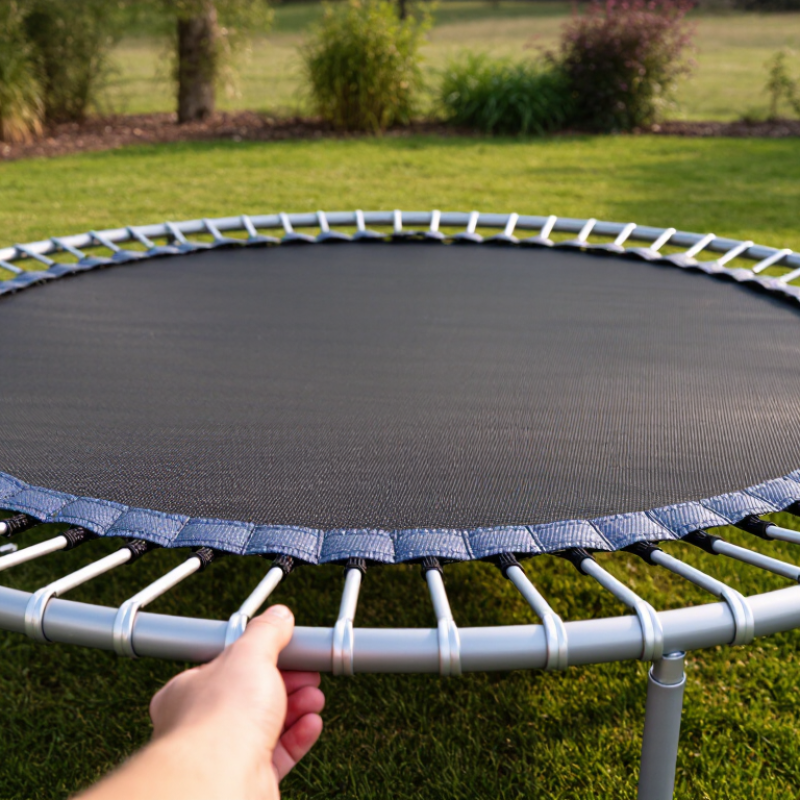
Identify Trampoline Type and Measure Frame Diameter in Inches
How to Choose a Trampoline Mat for Your Needs
Start by identifying the trampoline’s shape and construction. Round, oval, and rectangular frames need mats made for those specific shapes. A spring-based trampoline also needs a mat with the right number and placement of attachment rings. Springless models use different connections, so a standard spring mat will not fit. Check the frame or manual for its listed size before shopping.
For a round trampoline, measure straight across the frame through its center, from the outside edge of the metal frame to the opposite outside edge. Record the result in inches. Measure across a second direction too; noticeably different numbers may signal an uneven frame or a measuring error. For rectangular models, record both the outside length and width instead—diameter does not apply. Then count the springs and measure one spring from hook to hook while it is removed. A close fit matters. A mat that seems almost right may still attach poorly.
Tips: Measure the frame, not the old mat, which may have stretched. Recheck your numbers; this part can feel fussy, but guessing is riskier. Compare shape, frame dimensions, spring count, and spring length before ordering. If any measurement conflicts with the manufacturer’s specifications, pause and verify it.
Match Mat Diameter, Spring Count, and Spring Length to the Frame
A trampoline mat must fit the frame, not just match the size printed on a box. Measure the frame across its outer edge, then check the mat’s diameter using the maker’s stated measuring points. Those points can differ, so compare dimensions from the same source when possible. Measure twice. A small mismatch can leave the edge slack or make installation difficult.
Count the frame’s spring holes and the mat’s attachment points. They should match exactly, with attachments spaced evenly around the perimeter. For example, a frame with 72 spring holes needs a mat designed for 72 springs, not merely one with a similar diameter. Count carefully; rust or dirt can hide a hole. I once assumed two frames of equal diameter used the same layout. They did not.
Spring length matters too. Measure a spring from hook tip to hook tip while it is relaxed, and compare that measurement with the replacement mat’s specifications. A spring that is too short may be hard to attach; one that is too long can leave the mat loose. Check the frame maker’s fit guidance if dimensions conflict, and don’t force a doubtful fit. Exact measurements are helpful, but old frames can be slightly distorted, which is easy to overlook.
Compare Polypropylene Mesh, UV Ratings, and Weather Resistance
A trampoline mat’s polypropylene mesh should feel firm, with evenly spaced openings and reinforced stitching around the edge. Mesh quality depends on yarn thickness, weave, seam construction, and use—not material name alone. Ask whether the mat was tested for ultraviolet aging, and request the test method and exposure duration. ASTM G154 describes accelerated weathering with fluorescent UV light and moisture; it is a test practice, not a guarantee of outdoor lifespan. A dark mat can look sturdy. Looks can mislead.
UV exposure matters even when the mat stays dry. The World Health Organization’s Global Solar UV Index guide classifies levels 0–2 as low, 3–5 as moderate, and 6 or higher as high. That index measures exposure risk, not mat durability, but it helps explain why sunny locations need stronger UV protection. “UV-rated” alone is vague: check for test results and whether the rating addresses fading, strength loss, or both. Weather resistance also depends on water drainage, temperature changes, and how quickly the mat dries after rain.
Tips:
Compare stitching, mesh density, UV-test details, and warranty exclusions.
Remove pooled water and let the mat dry before covering it.
If winters are harsh, store the mat indoors when practical; even a well-tested fabric can wear sooner in real conditions than in a laboratory.
One detail is easy to miss: inspect the perimeter seams, where tension concentrates during repeated bouncing.
Check Mat Weight Capacity and ASTM F381 Safety Requirements
When choosing a replacement trampoline mat, check the complete trampoline’s stated maximum user weight, not just the mat’s dimensions. The mat, springs, frame, and attachment points work as one load-bearing system. A replacement with the wrong size or hook layout can strain the frame or leave gaps. Check the label. If the capacity is unclear, contact the manufacturer or choose a compatible replacement with documented specifications.
ASTM F381 covers trampoline components, assembly, and use; it is not a guarantee that a mat alone is safe or certified. Look for evidence that the complete trampoline meets the standard, and confirm that the replacement mat matches the model’s dimensions and attachment system. The U.S. Consumer Product Safety Commission’s trampoline safety materials have cited estimates exceeding 100,000 trampoline-related emergency-room injuries annually. That figure is a warning, not a prediction for any individual trampoline. Before use, inspect stitching, hooks, and the frame for wear, and follow the product’s user-weight limit. I would not rely on a mat that merely looks sturdy; its fit and the system’s documented capacity matter more.

 '
'
