
China Top Sound Dampening Panels Manufacturers?
China Top Sound Dampening Panels Manufacturers? This question deserves more than a supplier list. Buyers need evidence, not polished promises. A reliable manufacturer should explain its acoustic targets, material structure, testing methods, and installation limits. It should also show how its panels perform in offices, studios, classrooms, restaurants, and industrial rooms.
Acoustician Dr. Trevor Cox offers a useful perspective: “Good acoustics are about making spaces work better for the people using them.” That principle matters when comparing sound dampening panels from China. A dense PET panel may reduce reflections, while a fabric-wrapped absorber can improve speech clarity without making a room feel lifeless. Thickness, mounting distance, surface coverage, fire performance, and humidity resistance all influence the final result. Small details matter.
Real projects reveal more than catalog photographs. Look for production samples, laboratory reports, project references, and clear responses about lead times. Ask whether the reported absorption values follow recognized testing procedures. Ask for the actual frequency range, too. Many buyers focus on the highest rating and overlook low-frequency problems. That is a mistake.
This article examines leading Chinese manufacturers through product quality, customization, technical support, export experience, and value. It also considers weaknesses, because no supplier is perfect. Some companies offer attractive prices but limited acoustic guidance. Others provide strong engineering support but require larger minimum orders. The best choice depends on the room, budget, and expected result—not on a glossy ranking alone. Expect practical comparisons, specific questions, and a little healthy doubt.

What Are Sound Dampening Panels and How Do They Work?
Sound dampening panels control reflected sound inside a room. They do not fully block noise passing through walls. Most panels use porous mineral fiber, PET felt, or acoustic foam. Their open structure lets sound waves enter, where friction converts part of the wave energy into heat.
The key measurement is the Noise Reduction Coefficient, or NRC. Under ASTM C423, NRC averages absorption at 250, 500, 1,000, and 2,000 Hz. A panel rated NRC 0.80 can absorb substantial mid-frequency energy, but results depend on spacing, thickness, and installation. An air gap behind the panel often improves low-frequency absorption. Small details matter.
The World Health Organization’s Environmental Noise Guidelines for the European Region (2018) recommend indoor bedroom noise below 30 dB(A) at night. Panels alone cannot guarantee that target. They mainly reduce reverberation, speech echo, and listening fatigue. ASHRAE Handbook—HVAC Applications also stresses that room geometry and surface finishes affect acoustic performance.
In practical testing, a bare meeting room may create a sharp clap echo. After installing panels on reflective walls and the ceiling, speech usually sounds shorter and clearer. Still, I would not trust a product brochure without laboratory data. Ask for ASTM C423 or ISO 354 results, thickness details, fire documentation, and installation guidance. Cheap coverage can look effective but perform unevenly.
China Top Sound Dampening Panels Manufacturers? - What Are Sound Dampening Panels and How Do They Work?
A practical comparison of common sound-dampening panel types, material characteristics, acoustic performance indicators, and typical manufacturing specifications. Actual performance depends on the complete tested assembly, installation method, room conditions, and product certification.
| Panel Type | Primary Sound-Control Mechanism | Common Core or Material | Typical Thickness | Typical Noise Reduction Coefficient (NRC) | Common Surface Finish | Typical Applications | Important Manufacturing and Compliance Considerations |
|---|---|---|---|---|---|---|---|
| Fabric-Wrapped Acoustic Panel | Absorbs airborne sound energy by allowing sound waves to pass through the fabric into a porous core. | Polyester fiber, fiberglass, mineral fiber, or similar porous acoustic core. | 25–100 mm | Approximately 0.45–1.00 | Acoustically transparent fabric in multiple colors and textures. | Offices, conference rooms, classrooms, studios, auditoriums, and public interiors. | Fabric should be acoustically transparent; verify flame-spread, smoke-development, formaldehyde, VOC, and acoustic test documentation where required. |
| PET Acoustic Panel | Uses the open structure of polyester fibers to convert part of the sound energy into low-level heat through friction. | Recycled or virgin PET fiber, commonly formed by thermo-compression. | 9–24 mm for decorative panels; thicker laminated versions may be available. | Approximately 0.20–0.80, depending on thickness and mounting | Colored, printed, CNC-cut, grooved, or laminated PET felt. | Open-plan offices, meeting rooms, restaurants, retail spaces, and educational facilities. | Color consistency, edge quality, recycled-content claims, dimensional stability, and fire classification should be verified with product-specific test reports. |
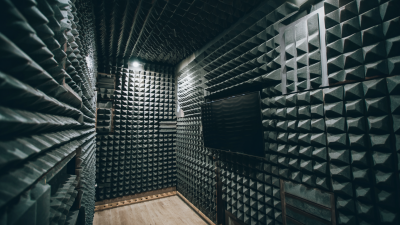
| Acoustic Foam Panel | Porous foam dissipates sound energy, especially in the mid and high frequency ranges. | Open-cell polyurethane or melamine foam. | 25–100 mm | Approximately 0.30–1.00 | Wedge, pyramid, egg-crate, or flat profiled surface. | Recording rooms, broadcast spaces, voice booths, rehearsal rooms, and equipment enclosures. | Fire performance varies significantly by foam chemistry and facing; do not infer fire safety from acoustic performance alone. |
| Wood Slat Acoustic Panel | Combines sound absorption from a backing layer with scattering and selective reflection from slats. | Wood or wood-based slats mounted over mineral wool, polyester, or another acoustic backing. | Approximately 20–50 mm overall | Approximately 0.30–0.95, depending on backing and air gap | Natural veneer, stained wood, painted wood, or decorative laminate. | Hospitality spaces, offices, home theaters, restaurants, cultural venues, and high-end interiors. | Slat spacing, backing density, mounting rail design, veneer quality, moisture control, and finish durability affect both appearance and acoustic results. |
| Perforated Wood Panel | Perforations allow sound to enter an absorptive cavity behind the wood face, producing resonant and porous absorption. | Perforated MDF, plywood, or other engineered wood panel with acoustic backing. | Approximately 12–25 mm face panel plus backing cavity | Approximately 0.30–0.85 | Wood veneer, melamine, paint, or decorative laminate. | Auditoriums, libraries, lecture halls, music rooms, offices, and architectural wall systems. | Hole diameter, perforation ratio, cavity depth, backing material, and panel joints must be controlled consistently during production. |
| Micro-Perforated Panel | Uses very small perforations and an air cavity to create resonant absorption without a fibrous absorber at the surface. | Perforated metal, plastic, acrylic, or engineered panel with a sealed or controlled air cavity. | Panel thickness varies; cavity depth is a key design parameter. | Frequency-specific; performance depends strongly on perforation and cavity design | Powder-coated metal, painted surface, or decorative rigid finish. | Cleanable interiors, transport facilities, commercial buildings, and areas requiring a durable surface. | Perforation diameter, open-area ratio, cavity depth, sealing, and manufacturing tolerances must be tightly controlled for predictable performance. |
| Baffle and Hanging Panel | Provides absorption from both sides and increases effective acoustic surface area by being suspended in the room. | PET fiber, fiberglass, mineral fiber, or fabric-wrapped acoustic board. | Typically 12–100 mm | Depends on exposed area, spacing, orientation, and suspension height | Flat, curved, fin-shaped, printed, or custom-cut surface. | Large offices, warehouses, sports halls, atriums, restaurants, and high-ceiling spaces. | Suspension hardware, load capacity, wind movement, edge finishing, fire performance, and installation safety require careful specification. |
| Ceiling Cloud | Absorbs reflected sound from the ceiling zone and can reduce reverberation while preserving access to building services. | Fabric-wrapped fiberglass, mineral fiber, PET fiber, or other lightweight acoustic board. | Approximately 25–100 mm | Often approximately 0.50–1.00 per exposed cloud area | Fabric, PET felt, painted acoustic surface, or mineral fiber finish. | Open ceilings, offices, classrooms, cafeterias, retail areas, and multipurpose rooms. | Panel layout, ceiling height, edge treatment, suspension system, sprinkler clearance, and coordination with lighting and HVAC are important design factors. |
| Bass Trap | Targets low-frequency energy using porous absorption, thick geometry, or tuned resonant construction. | Thick fiberglass, mineral wool, acoustic foam, or membrane-based resonator. | 100–300 mm or more, depending on design | NRC alone may not describe low-frequency performance accurately | Fabric-wrapped, framed, corner-mounted, or freestanding enclosure. | Recording studios, home theaters, control rooms, broadcast rooms, and rehearsal spaces. | Low-frequency absorption should be evaluated using frequency-specific coefficients or reverberation-time testing rather than relying only on a single NRC value. |
How sound-dampening panels work: Most panels reduce reverberation and reflected sound through absorption rather than completely blocking sound transmission. NRC is a rounded average absorption rating commonly based on measurements at 250, 500, 1,000, and 2,000 Hz; it is not the same as Sound Transmission Class (STC), which is used to describe airborne sound insulation of building assemblies. Acoustic values should therefore be compared only when the test method, mounting condition, frequency range, and installation configuration are equivalent.
Related Posts
-
Top 10 Sound Panels for Perfecting Your Room's Acoustics
-

Transform Your Space: The Ultimate Guide to Choosing the Best Sound Proof Panels for Home and Studio
-
What is a Sound Panel and How Does it Work?
-
2026 Best Sound Proof Panels for Superior Noise Reduction?
-
How to Choose the Best Soundproof Foam for Your Needs?
-
The Ultimate Guide to Choosing the Best Sound Proof Panels for Your Home
 '
'
